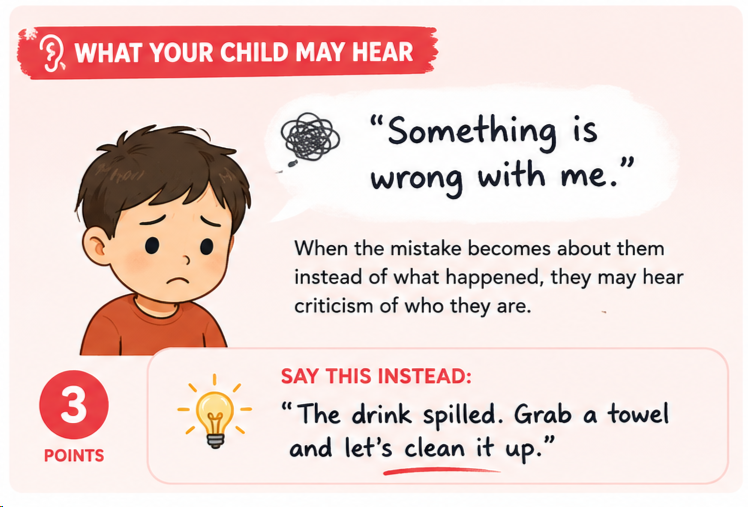
“Something is wrong with me.”
“What is wrong with you?” can turn one mistake into a message about who they are.
SAY THIS INSTEAD
“The drink spilled. Grab a towel and let’s clean it up.”


You’ve seen what individual phrases can sound like to your child.
Now see the pattern across your 7 answers — including where your words tend to shift most when you're tired, rushed, frustrated, or overwhelmed.
Then visually show what they're about to unlock:
Your personalized result includes:
You tend to focus on what happened rather than turning the mistake into a label about who your child is.
[/ShowCategoryScoreJS]You tend to focus on what happened rather than turning the mistake into a label about who your child is.
[/CloneShowCategoryScore]When frustration rises, labels or criticism can sometimes slip into your words. The key shift is separating who your child IS from what they DID.
[/ShowCategoryScoreJS]When frustration rises, labels or criticism can sometimes slip into your words. The key shift is separating who your child IS from what they DID.
[/CloneShowCategoryScore]This pattern shows up strongly in your answers. When you’re frustrated, your words can shift from addressing the behavior to describing your child — with phrases like “lazy,” “careless,” or “what’s wrong with you?”
[/ShowCategoryScoreJS]This pattern shows up strongly in your answers. When you’re frustrated, your words can shift from addressing the behavior to describing your child — with phrases like “lazy,” “careless,” or “what’s wrong with you?”
[/CloneShowCategoryScore]You tend to make room for your child’s feelings while still holding the boundary.
[/ShowCategoryScoreJS]You tend to make room for your child’s feelings while still holding the boundary.
[/CloneShowCategoryScore]When emotions get big, your instinct can sometimes be to make the feeling stop — with words like “you’re okay,” “calm down,” or “it’s not a big deal.”
[/ShowCategoryScoreJS]When emotions get big, your instinct can sometimes be to make the feeling stop — with words like “you’re okay,” “calm down,” or “it’s not a big deal.”
[/CloneShowCategoryScore]Big emotions appear to be one of your harder moments. When crying, anger, or disappointment escalates, your words can focus on stopping the emotion rather than helping your child move through it.
[/ShowCategoryScoreJS]Big emotions appear to be one of your harder moments. When crying, anger, or disappointment escalates, your words can focus on stopping the emotion rather than helping your child move through it.
[/CloneShowCategoryScore]<p>Even when you need to set a firm limit or take space, you generally keep the boundary separate from your connection with your child.</p>
[/ShowCategoryScoreJS]<p>Even when you need to set a firm limit or take space, you generally keep the boundary separate from your connection with your child.</p>
[/CloneShowCategoryScore]In this situation, frustration started to enter the boundary. A small shift toward calm, specific language can keep the limit clear without making your child feel pushed away.
[/ShowCategoryScoreJS]In this situation, frustration started to enter the boundary. A small shift toward calm, specific language can keep the limit clear without making your child feel pushed away.
[/CloneShowCategoryScore]In this situation, stronger warnings or distancing language came through when patience was running low. The shift is to keep the limit firm without making connection feel threatened.
[/ShowCategoryScoreJS]In this situation, stronger warnings or distancing language came through when patience was running low. The shift is to keep the limit firm without making connection feel threatened.
[/CloneShowCategoryScore]You tend to notice your reactions and find different words, even when old parenting language shows up in your head.
[/ShowCategoryScoreJS]You tend to notice your reactions and find different words, even when old parenting language shows up in your head.
[/CloneShowCategoryScore]Under pressure, familiar words can sometimes take over before you have time to choose a different response. You often know what you wish you’d said afterward.
[/ShowCategoryScoreJS]Under pressure, familiar words can sometimes take over before you have time to choose a different response. You often know what you wish you’d said afterward.
[/CloneShowCategoryScore]This is a strong pattern in your answers. When you’re tired, angry, or overwhelmed, old reactions can take over — including words you may have heard growing up and promised yourself you wouldn’t repeat.
[/ShowCategoryScoreJS]This is a strong pattern in your answers. When you’re tired, angry, or overwhelmed, old reactions can take over — including words you may have heard growing up and promised yourself you wouldn’t repeat.
[/CloneShowCategoryScore]